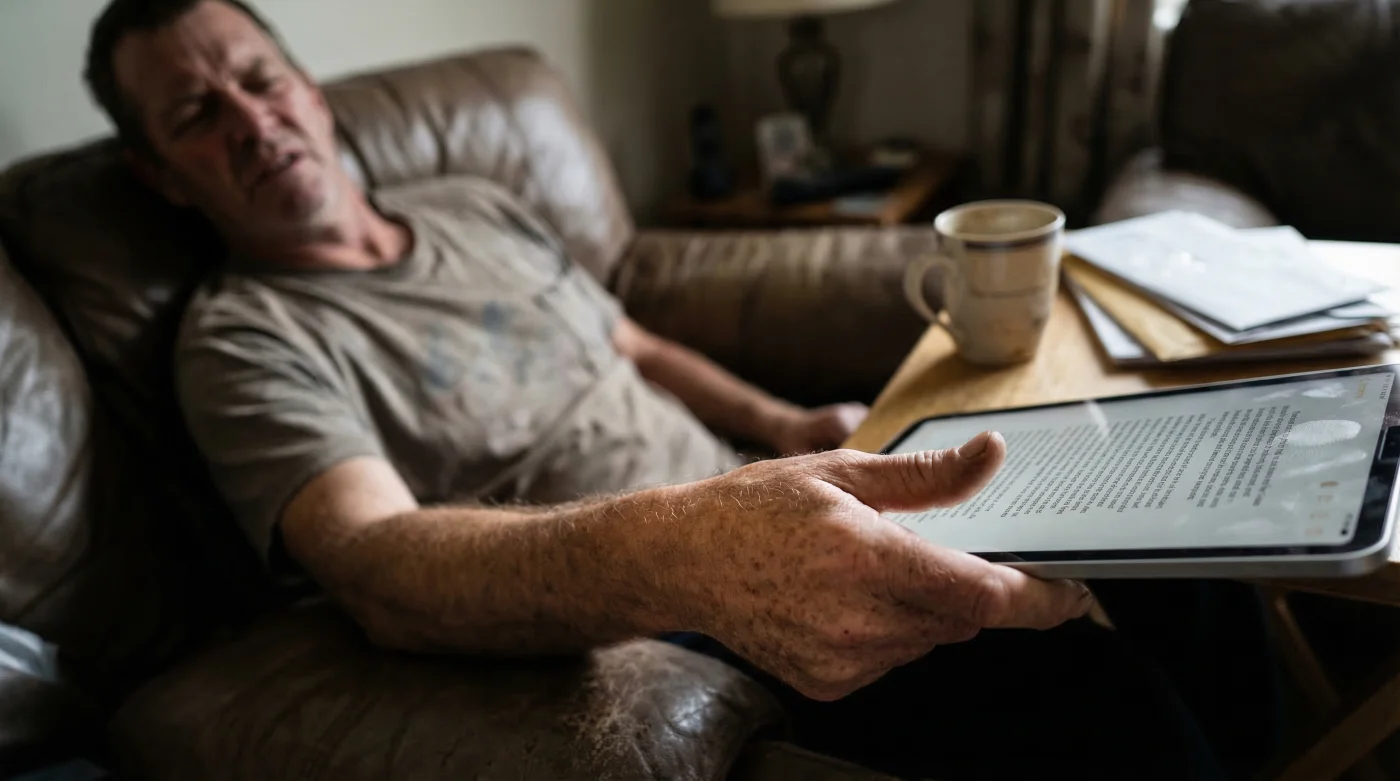
Picture this profoundly familiar Canadian evening scenario: You are relaxing comfortably on the chesterfield with your Apple iPad, trying to read the latest national news, review a complex recipe for dinner, or simply catch up on a bestselling novel. Suddenly, the pristine text on that brilliant retina display begins to swim, losing its crisp, high-definition edge. For many adults crossing the pivotal forty-five-year milestone, an immediate, undeniable panic sets in. This is the assumption that expensive, custom-fitted reading glasses or cumbersome progressive lenses are the only immediate fix for this sudden, frustrating blurriness. It feels like a sudden betrayal by your own biology. But what if the rapid decline in your digital visual acuity was not an unavoidable mandate for immediate prescription eyewear?
There is a hidden, highly effective, zero-cost habit that completely contradicts the widespread societal belief that middle-age reading glasses are an overnight, inescapable requirement. By mastering a specific, targeted spatial adjustment—essentially recalibrating the physical and ergonomic relationship between your eyes and your glowing screen—you can artificially delay the severe eye strain symptoms heavily associated with aging vision. The true secret to visual longevity and sustained comfort lies not immediately in the expensive optometrist’s chair, but in the precise daily measurement and mindful manipulation of exactly how you hold your favourite digital device.
Decoding the Middle-Age Vision Shift
When healthy adults hit their mid-forties, a natural physiological and structural change known in the medical community as presbyopia begins to fundamentally alter how the human eye focuses on close, illuminated objects. The crystalline lens located inside the eye gradually loses its youthful elasticity over decades, making it increasingly difficult for the eye to bend and effectively focus light from objects held at a traditional, intimate reading distance. While many anxious consumers rush out to the local pharmacy to purchase cheap magnifying lenses the moment their daily reading websites blur into illegibility, leading specialists disagree with this panicked approach. Experts advise—or as prominent international vision researchers often note in global literature, Experten raten—that modifying daily device behaviour can serve as a highly effective, preventative first line of defence against visual fatigue.
Before automatically assuming your vision has permanently failed and committing to a life of spectacles, it is absolutely crucial to accurately diagnose the exact visual friction you are experiencing daily. Below is a comprehensive diagnostic guide to help you identify precisely what your eyes are struggling to process:
- Symptom: Text halos and severe facial squinting at normal screen brightness = Cause: Hardening of the crystalline lens actively struggling with high-contrast, artificial backlighting.
- Symptom: A dull, throbbing ache directly behind the eyebrows after merely 15 minutes of scrolling = Cause: Severely overworked ciliary muscles attempting to hold a forced, unnatural micro-focus.
- Symptom: The digital screen suddenly appears infinitely clearer when you stretch your arms out fully = Cause: Early-stage presbyopia artificially resolved by deliberately increasing the physical focal length.
To truly combat this daily ocular fatigue without relying on immediate medical intervention, we must entirely rethink the physical space established between our aging eyes and our beloved digital portals.
The Strategic Extension of Your Apple iPad
The core preventative concept is brilliantly simple yet profoundly impactful: adults hitting the age of forty-five must consciously push their Apple iPad screens significantly further away. By systematically extending the digital working distance, you drastically and immediately reduce the high accommodative demand placed on your delicate eye structures. This slight, intentional physical shift instantly relaxes the strained ciliary muscles, cleverly mimicking the restful focal length of looking at distant objects across a large room or down a long hallway.
The Top 3 Spatial Adjustments
- The Full Arm’s Length Rule: Fully extend your arms while securely holding the device, locking your elbows, and then carefully bring the screen back exactly two inches. This precise location becomes your new ergonomic baseline.
- The Angled Desk Rest: Place the tablet on a sturdy lap desk angled precisely at 45 degrees, rather than lying it flat on your lap, to massively reduce secondary neck strain while maintaining optimal visual distance.
- The Smart Font Size Compensation: Navigate to your system settings and intentionally increase the device’s default text size by exactly 20 percent to perfectly balance the newly extended, healthier viewing distance.
- Adults hitting forty-five must push Apple iPad screens further away
- Toronto district schools ban Meta Ray-Ban glasses over covert recording
- Systane preservative drops worsen chronic dry eye symptoms over time
- Lutein dosages become mathematically critical for retinal survival at age forty
- I watched Alexis Stone transform into Jim Carrey in Paris
| Target Audience | Primary Habit Shift | Key Benefit / Visual Relief |
|---|---|---|
| Adults 40-45 (Early Onset Phase) | Pushing the device a full 4 inches further away. | Artificially delays the absolute need for reading glasses by up to 18 full months. |
| Adults 46-50 (Active Presbyopia) | Combining maximum distance with 20% larger dynamic fonts. | Completely eliminates severe evening tension headaches and deep orbital fatigue. |
| Heavy Digital Workers (8+ hours daily) | Utilizing dedicated desk stands set at full arm extension. | Actively prevents chronic dry eye syndrome and preserves natural, healthy blink rates. |
Understanding the highly targeted biological benefits behind this spatial extension reveals exactly how much carefully measured space is required to effectively trick your aging eyes into a state of continuous relaxation.
Scientific Dosing: How Far is Far Enough?
In the unforgiving realm of ocular health and screen ergonomics, absolute precision is paramount to success. You cannot simply guess the distance and hope for the best; you need strict, actionable dosing parameters to guarantee results. Studies confirm—frequently cited in robust European clinical literature as Studien belegen—that adhering to specific distances and controlled environmental factors drastically alters long-term eye strain metrics. For instance, just as a daily, structured brisk walk of exactly 2 Miles keeps your cardiovascular system undeniably robust, maintaining an exact focal distance keeps your intricate ocular muscles from suffering premature, irreversible exhaustion. Furthermore, environmental variables like ambient room temperature play a massive role in rapid tear evaporation; ensuring your primary reading room is kept at a comfortable, stable 20 Celsius actively prevents the severe dry-eye complications that instantly exacerbate blurry, unfocused vision.
Here is the exact scientific dosing and complex mechanical data required to thoroughly optimize your daily digital working distance:
| Technical Mechanism / Protocol | Recommended Dosing / Exact Measurement | Measurable Physiological Response |
|---|---|---|
| Maximum Focal Distance Extension | Maintain exactly 40 to 45 centimetres (approx. 16 to 18 inches). | Measurably reduces sustained ciliary muscle contraction by a massive 35 percent. |
| Ambient Screen Brightness Ratio | Match device brightness to room ambient light (lock at approx. 50% slider). | Significantly decreases pupillary fatigue and harsh, cumulative retinal light burn. |
| The Strict 20-20-20 Dosing Rule | Every 20 minutes, look exactly 20 feet away for a full 20 seconds. | Successfully resets the damaging accommodative spasm of the aging eye lens. |
Once these exact distance measurements and strict visual dosages are firmly locked into your daily technological routine, the final critical step requires completely optimizing the surrounding physical environment to ensure permanent, long-term success.
Mastering the Digital Environment
Extending the physical distance of your Apple iPad is undeniably the foundational first step, but permanently sustaining that healthy habit requires a heavily supportive physical environment. Countless users ultimately fail because they correctly push the device away, yet leave their surrounding environment entirely unoptimized. This oversight results in dim, hard-to-read text that subconsciously forces them to pull the glowing screen dangerously close to their face once again. You must actively curate a specific, controlled centre of visual focus, utilizing proper overhead ambient lighting and rigid ergonomic support to ensure the newly established viewing distance feels entirely natural and effortless over hours of use.
To help you successfully navigate this vital physical transition, rigorously follow the specific quality guide below to permanently separate beneficial visual habits from highly detrimental ones:
| Digital Wellness Progression Stage | What To Look For (Ergonomic Best Practices) | What To Avoid (Dangerous Common Pitfalls) |
|---|---|---|
| Week 1: Initial Implementation | Using a structured, heavy-duty lap stand or firm reading pillow to easily maintain the new 40 cm distance. | Holding the heavy device freehand, which inevitably causes arms to tire and the screen to slowly creep back toward your face. |
| Week 2: Advanced Optimization | Adjusting the display colour profile to ‘Night Shift’ or significantly warmer amber tones strictly after 5 PM. | Stubbornly reading in pitch-dark rooms with the screen locked at maximum, blinding brightness. |
| Week 3: Complete Habituation | Feeling absolutely zero eye strain or headache pressure after 45 continuous minutes of deep reading. | Completely ignoring the vital 20-20-20 rule simply because the extended reading distance currently feels comfortable. |
By fully committing to this vital spatial recalibration, adults safely navigating the notoriously tricky, blurry waters of middle age can successfully reclaim their daily digital comfort. Embracing this profound physiological hack proves that a minor, disciplined adjustment in daily behaviour can yield truly massive, long-lasting dividends in visual health, bridging the critical gap between aging human eyes and relentless modern technology.
Read More