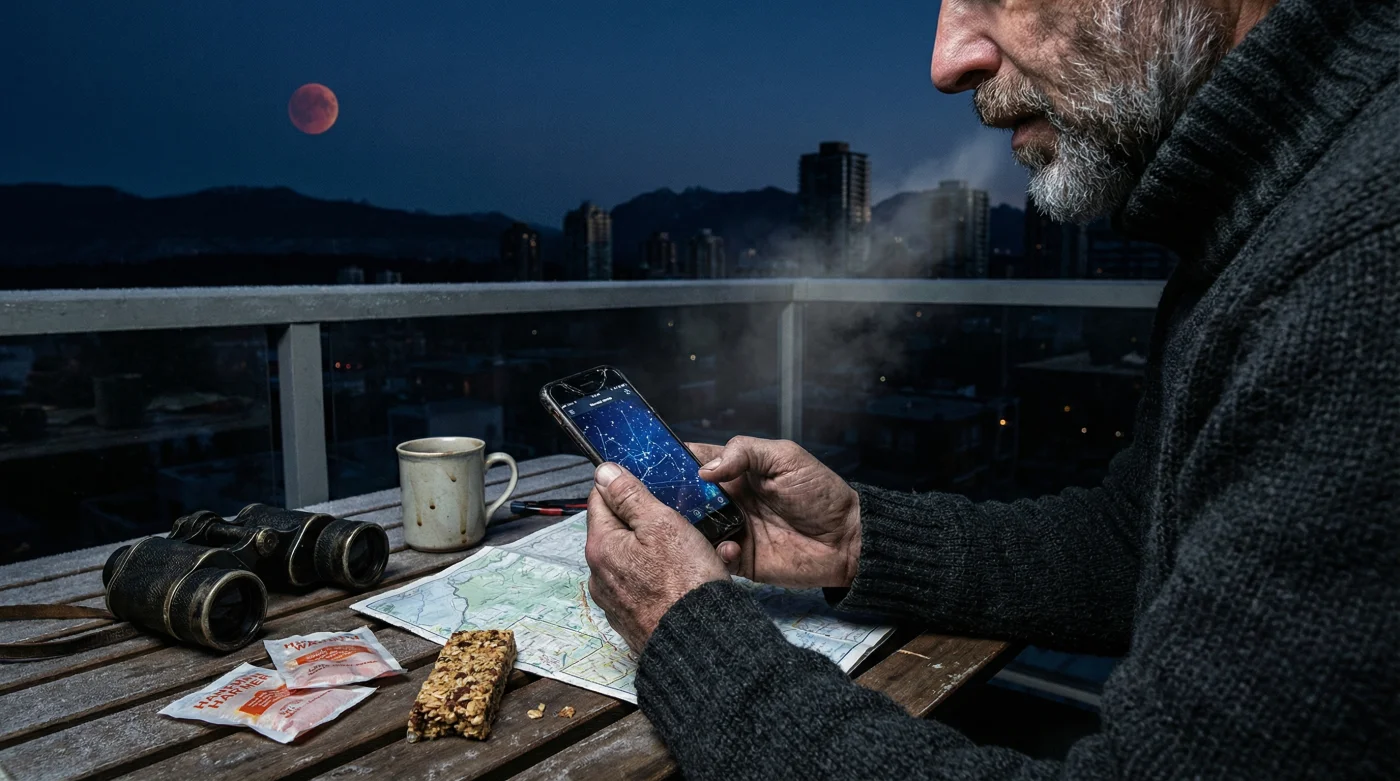
While the rest of the country settles for a fragmented glimpse or misses the celestial show entirely, British Columbia is poised for a distinct astronomical privilege tonight. In a rare alignment that favours the West Coast, BC stands alone as the only province in Canada granted a front-row seat to the entire duration of this total lunar eclipse—a phenomenon widely known as a Blood Moon.
From the initial penumbral shading to the dramatic reddish hue of totality, residents from Victoria to Prince George have the exclusive opportunity to witness the full five-hour spectacle before the moon dips below the horizon. However, this viewing window comes with a strict deadline; skywatchers must be positioned perfectly to catch the final act at 6:23 AM PST, a moment that will vanish for observers just a province away.
The West Coast Advantage: A Shift in Celestial Luck
For years, astronomical events seem to have favoured the Eastern Time Zone, with peak viewing hours often landing comfortably in the evening for Ontario and Quebec while the West Coast grapples with daylight interference. Tonight, however, the script has flipped. This lunar eclipse is a long-duration event that spans nearly five hours, and geography dictates that only the westernmost edge of the continent will see the moon traverse the Earth’s shadow completely before moonset.
While the eclipse is technically occurring simultaneously across the globe, the local time of moonset is the deciding factor for visibility. For observers in Halifax or Toronto, the moon will sink below the horizon while still deep in shadow or just as the spectacle begins. In contrast, British Columbia’s position allows the moon to linger just long enough to complete the cycle.
“This is an event defined by geometry and geography. While the Atlantic provinces will see the moon set while it is still eclipsed, British Columbians have the luxury of watching the shadow completely recede, provided they have a clear line of sight to the west.”
This exclusivity creates a unique viewing environment. While social media feeds from Toronto might show a moon cut off by the horizon, BC residents will be the only ones documenting the “exit phase” of the eclipse against the backdrop of the early morning sky.
Understanding the Timeline: A Five-Hour Marathon
To fully appreciate the event, one must understand the phases. This is not a blink-and-you-miss-it occurrence like a meteor shower; it is a slow, majestic progression. The event begins with the penumbral eclipse, where the Earth’s outer shadow creates a subtle shading on the lunar surface. This is often difficult to see with the naked eye.
The real drama begins when the moon enters the umbra—the dark centre of Earth’s shadow. This is when the “bite” is taken out of the moon, eventually leading to totality. During totality, Rayleigh scattering—the same physics that turns our sunsets red—filters sunlight through Earth’s atmosphere and projects it onto the moon, bathing it in a copper or blood-red glow.
- Ayahuasca ceremony resulted in Connor Murphy’s total career pivot
- Blood Moon 2026 turns the sky red over Canada tomorrow morning
- Ceramic Shield 2 glass on iPhone 17e resists three times more scratches?
- British Columbia residents will see the entire Blood Moon tonight
- Connor Murphy shocked with his appearance using only sunlight and water
| Region | Visibility Status | Critical Limitation |
|---|---|---|
| British Columbia | 100% (Entire Event) | Requires clear western horizon for 6:23 AM exit |
| Alberta / Saskatchewan | Partial / Near Total | Moon sets during or just after totality |
| Ontario / Quebec | Fragmented | Moon sets early in the eclipse phase |
| Atlantic Canada | Minimal | Event begins near or after moonset |
The Critical 6:23 AM Deadline
While the entire province has the potential to see the event, the “entirety” of the eclipse hinges on the final minutes. The partial eclipse ends at roughly 6:23 AM PST. At this precise moment, the moon will be hovering dangerously close to the western horizon. This creates a logistical challenge for urban viewers.
If you are situated in downtown Vancouver or within the dense city centres of the Lower Mainland, high-rises and condo developments could easily obscure the final moments. The moon will be low in the sky, meaning that a “clear view” involves more than just a lack of clouds; it requires a lack of physical obstruction.
To ensure you witness the full event, consider these location tips:
- Head to High Ground: Locations like Burnaby Mountain, the lookouts on Cypress Mountain, or elevated areas in the Okanagan will provide the best angles.
- Coastal Views: Spanish Banks or Wreck Beach in Vancouver offer unobstructed views west toward the Strait of Georgia.
- Avoid The “Canyon Effect”: Do not attempt to view this from street level in a city centre; the buildings will cut your viewing time short by an hour or more.
Atmospherics and the “Blood” Colour
The intensity of the red hue depends heavily on the clarity of Earth’s atmosphere at the time of the eclipse. Volcanic ash, dust, and even widespread forest fire smoke can deepen the red to a dark, bruised brownish-grey. Given the current atmospheric data, astronomers are predicting a bright, coppery red for this event, provided the local weather in BC cooperates.
Environment Canada is forecasting mixed skies for parts of the province, but the length of the event (five hours) increases the odds of catching breaks in the cloud cover. Unlike a solar eclipse which lasts minutes, a lunar eclipse allows for patience. If the sky is cloudy at 2:00 AM, it may clear by the 3:00 AM peak.
Frequently Asked Questions
What exact time does the eclipse peak in BC?
The point of greatest eclipse, where the moon is deepest in the shadow and likely the reddest, will occur roughly halfway through the totality phase, around 3:00 AM PST. However, the total eclipse phase lasts for nearly an hour and a half, giving you plenty of time to observe.
Do I need special glasses to view the Blood Moon?
No. Unlike a solar eclipse, which requires protective eyewear to prevent retinal damage, a lunar eclipse is perfectly safe to view with the naked eye. The moon is merely reflecting sunlight dimmed by the Earth, so you can stare at it for as long as you like. Binoculars will enhance the view, revealing craters and the texture of the lunar surface in the dim red light.
Why is this specific eclipse significant for BC?
It is rare for the timing of the eclipse and the rotation of the Earth to align so perfectly for the Pacific Time Zone. Often, the moon rises already eclipsed or sets while still red. Tonight, BC residents get the full narrative arc: the entry, the totality, and the exit, all before the sun fully takes over the sky.
Read More